Time Investing 101
Welcome to the Habit Chess newsletter where I talk about training everyday skills to make moves.
read time: ~5-6 minutes
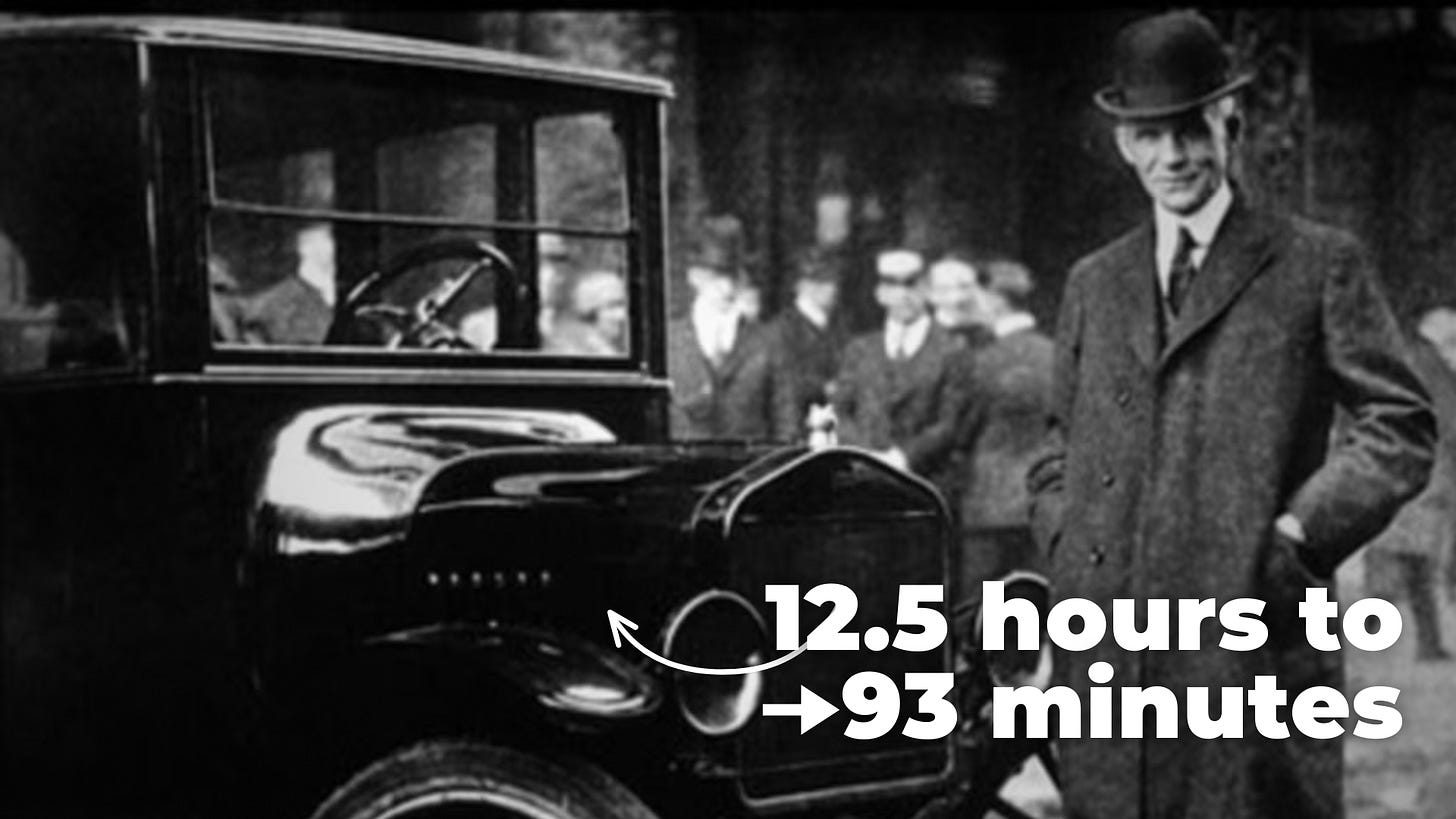
In 1913 at Ford’s Highland Park plant, building a single Model T took around 12.5 hours.
The work was divided into stations, but workers still had to walk, fetch parts, reposition tools, and move around the car itself. The process worked—but it wasn’t designed for flow.
Later that year, Ford’s team introduced a moving assembly line.
Instead of workers moving to the car, the car moved past the workers.
That single change dropped the build time to about 93 minutes.
Same team.
Same tools.
Same product.
The difference wasn’t effort.
It was visibility—seeing that time had a shape, and that shape could be redesigned.
That’s the real lesson of time investing.
And if you talk to great investors—the ones who see behind the curtain of hundreds of founders—they’ll tell you the same thing:
“One of the hardest things to get a founder to do is track their time.”
Everyone wants leverage.
Very few want visibility.
When I heard that, it clicked immediately:
Wait… I actually enjoy doing this.
And it took me back to my coaching years.
Food logs were always the hardest habit to get clients to do even for just a few days and easily the most transformative.
Somewhere in those years, another habit formed:
I tracked the exact time it took to write every single training program for every client.
Not “programming: 1.5 hours.”
But which program.
For which client.
For which week.
I did that for three years straight.
And when my roster grew from a handful of people to 60+, this level of detail wasn’t optional.
It was necessary.
It revealed where my effort was actually going and where systems needed to evolve.
That same muscle became foundational again when I built my consulting firm.
And again when I shifted into creative work.
Three different chapters.
One identical skill:
Trace the time → see the truth → redesign the flow.
The Unexpected Value of 4–5 Years of Time Data
I’ve tracked my time for years now. Not so much obsessively, but intentionally.
And the data became something far more valuable than I expected.
A memory bank.
A record of effort that feelings can’t distort.
And I didn’t just track how long something took.
I tracked exactly what it was.
Not:
“15 minutes on email.”
But:
which email,
to who,
about what.
Not:
“45 minutes on admin.”
But:
the exact task, the client, the deliverable, the decision.
Same with creative work—I know:
- which thumbnail took 37 minutes vs. which one took two hours
- which brief took 18 minutes to write and which took 76
- which edits took longer and why
This trains pattern recognition—how you build an honest relationship with your own effort.
And the funny thing is, a mentor I worked for once told me, “Assume anything will take you three times longer than it takes me.”
That little line stuck with me for years.
Most of us aren’t bad at the work—we’re just bad at estimating how long good work actually takes.
I could feed 5 years of my time investing data into ChatGPT and have it analyze what I did right or wrong.
But I don’t need to.
Track something long enough and the patterns become undeniable.
You see where friction repeats.
You see where leverage hides.
You see the moves worth making again.
Where This System Truly Began
A year or two into building my consulting business, I realized something unsettling:
Financially, I was basically at the same place as my old job—maybe $2,000 more one year, $2,000 less the next—but it didn’t feel like progress.
I couldn’t recall what I had actually done that year.
At the same time, I was doing standup—tracking sets, writing sessions, and open mics. My attention was split across so many projects that I couldn’t see the shape of my effort anymore.
That’s when I needed evidence.
Something objective.
Something real.
Something that could show me what my time was actually becoming.
This tracker became that anchor.
It tells the truth if you use it. Whether you made progress, whether something mattered, or whether you were simply busy.
Over time, that perspective becomes priceless.
And there’s something almost unavoidable about tracking anything:
The moment you measure it, you start improving it.
Not because you force yourself to, but because measurement breaks the illusion.
It shows you reality without narrative, and once you see reality, you naturally begin to optimize.
Tracking isn’t about control.
It’s about clarity.
And clarity quietly improves the outcome.
Speed Isn’t the Metric. Understanding Is.
I don’t track my time to become a machine.
I track it to understand myself.
My personal test is simple:
If I ever got dementia one day, would this tracker help me revisit the details of my life?
That question forces clarity.
It pushes me to track what actually matters—the work, the patterns, the reps, the seasons, the momentum.
Your use cases might be different:
- Understand how long components of your work truly takes
- Build evidence of progress
- Reduce friction
- Design days that compound
- Stop guessing where the time went
Whatever your reason, the same truth applies:
When you track your time even lightly, the assumptions disappear.
You stop relying on mood.
You stop gaslighting yourself about your effort.
You start seeing reality.
And reality is the only place leverage lives.
The Time Investing Journal (My Daily Clock-In, Clock-Out)
I don’t often stick with habits for 4–5 years without getting bored.
But this stuck.
Not because it’s productive.
Because it’s grounding.
It’s how I clock in and clock out of each task.
How I anchor the day.
How I understand what I’m really building.
The tool I use daily is the Time Investing Journal—a Notion system I’ve used daily for years. Hundreds of my YouTube viewers have downloaded this and it’s polished enough for you to use too.
Ford didn’t tell his team to work harder.
He redesigned the flow.
You can do the same.
Time investing isn’t about speed.
It’s about understanding.
And understanding compounds.
If you want to start investing your time the way Ford redesigned his assembly line, this is where I’d begin.
Download your Time Investing Journal here.
In your corner,
Misbah Haque
Founder of Pod Mahal & Habit Chess
P.S. If you enjoyed this, share it with someone who might find it useful by forwarding this email.