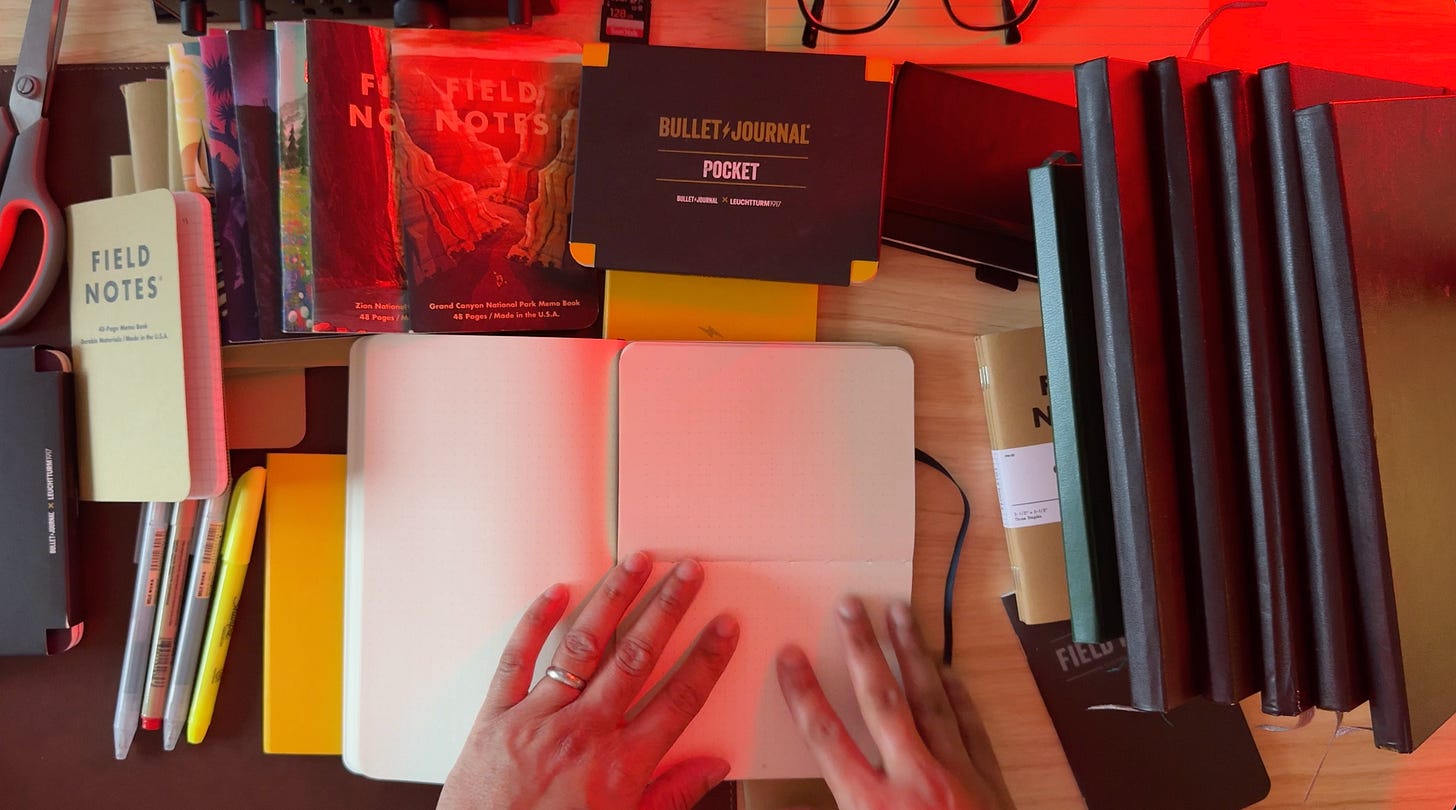
In the first several years, I related to my journal from a morning pages point of view. I’d brain dump and free write for three pages without stopping and without overthinking. I didn’t consider myself the best speaker at the time, so it was a way to practice improv a little bit through writing.
I’ve used this tool in so many different ways since. You’ve probably picked up a notebook randomly here and there, written down a couple of thoughts, and had the same feeling. Why don’t I do this more often? This feels good, right?
1. It’s got to feel good
The fact that it just feels good is enough reason to do it more. There are so many benefits of using handwriting as a thinking tool that if you find a way to make journaling feel good, you are more likely to return to it.
I love the morning pages style, but if I tried to do that all day, every day, it wouldn’t be as motivating. Maybe that’s a once a day type thing. Being able to come back, write a bullet or a sentence, close it back up and move on is another way of journaling. It’s commonly known as bullet journaling. Finding a hybrid that actually feels fun for you, that you can see yourself returning to, is one of the best ways to start.
In many cases, it looks like this:
- Finding a pen that you really enjoy using.
- Finding a notebook that you’re excited to carry around and excited to open up.
- Finding a style of writing that doesn’t put pressure on you.
If you pressure yourself to write things down word for word as you’re thinking them, that can be very stressful. Sometimes two words are enough. Two words that trigger the thought and let you fill in the gap. Your brain can’t help but fill in the gaps once it sees those two words. Oh, right. This is what it meant. There’s just enough there to retrieve the memory of what you were thinking when you jotted it down.
Remember that journaling is a process that is for you. Your journal is not something you are writing for other people to read. That’s where a lot of the pressure comes from: you feel like you’re being watched and judged. My grammar can’t be off. My spelling has to be perfect. None of that matters.
And a lot of times, you won’t even go back to retrieve these thoughts. It is enough for it to be a thinking tool. To work something out in the moment, to gain clarity on an idea, or to simply see the idea on paper so you can add shape to it.
Journaling isn’t something somebody is forcing you to do. You have to make yourself want to do it. A notebook you don’t like, a pen that’s not pleasant to use, a style that’s not aligned with what you’re trying to do: all of that works against it feeling good, and you’re less likely to do it.
2. Carry around a pocket notebook
This is something I romanticized all 17 years. Oh, I should carry around a pocket notebook. But I never actually enjoyed using one until the last six months or so.
What changed it for me was rotating the pocket notebook vertically. Now it operates as a standard A5 journal-sized page, and I found myself returning to it more often than my bigger journal. That was unthinkable for most of the 17 years, if you’ve seen all the journals I’ve filled up.
So I asked myself why. It’s small enough that I can actually carry it around. It’s a little bit bigger than my phone. I don’t take it everywhere (on a walk, I just use my notes app), but moving from space to space in my home, it’s always in my vicinity. I’m never without a pen and my notebook nearby.
Which is the same reason you pick up your phone so much. Your phone is always near you. I did a test called landlining, where my phone was plugged into a stand in another room, and I was just less likely to pick it up. I was not scrolling as much. You can use that same thing to help you journal more. If it looks good and feels good, you are more likely to reach for it when it is also near you.
Timestamps and Bullets
If you’re revisiting your journal multiple times a day, you need a quick way to capture. I bullet journal, but I don’t have all the symbols and make it perfect. Everything is usually just a bullet. Later I might annotate the sides: an arrow for this is important, catalog this, or a little checkbox for a to-do.
One of the main things I do: on the left-hand side, before the first note, I write the time. It’s fun to look back on. I’ll open to a random page and be like, whoa, at 12:15 a.m. this is what I was thinking about. And look how that’s evolved, or how it stayed the same. Your future self will appreciate having date and time stamps.
It’s also a feedback mechanism that’s not that harsh on you. Sometimes I open up to a Tuesday where only half of three lines have been filled, and it almost is embarrassing. Oh wow, I didn’t even write a full page on this day. Every time you open up, you see when the previous note was. An hour ago? Six hours? Two days?
Just by doing that, I write more often, because I don’t want to see more than a few hours go by without any notes logged. If 7:50 p.m. is the last time I wrote something and now it’s 11:35 p.m., that to me is like, oh wow, so much happened in the past four hours. What am I stuck on? What can I reflect on? It gives you a reason to come back.
Morning pages often take 15 to 20 minutes unbroken. You may not always have that kind of time. If that’s the only technique you associate with journaling, you won’t see a path to coming back to it multiple times a day, multiple times an hour. Bullet journaling is the most approachable way to do that.
3. Use it as a thinking tool for a project
Pick a project you can attach this journal to. Sometimes this is only necessary to get you into the habit of reaching for it automatically.
Let’s say you’re focused on getting a six pack or losing 15 pounds. What are you eating? When are you drinking water? What workouts did you do? What workouts are you going to do this week? All of those thoughts give you a reason to come back to this thing, and to see it as a journal for helping you get closer to that goal.
Reflection
That project also gives you a reason to use your journal for retrieval, which is the other part of journaling that I really enjoy and don’t use nearly as much as I should: reflection.
You don’t even have to write. Open up to any previous page and just begin reading. Revisiting older entries is going to trigger new ones, or something you want to annotate in the margin or catalog somewhere else.
I probably do this once a week, but I would like to be doing it once a day, because it is just that effective in helping you continue to work on an idea. Sometimes when you feel like you’re starting from scratch, you can look back a few pages and be like, oh, right. I already thought through all of this.
Aversion journaling
Aversion journaling is something Chris Bailey talks about in his book Intentional. It’s for when you’re procrastinating, when you’re not doing what you know you should be doing. Instead of doing the task, you aversion journal. Why am I not doing this? What is getting in the way?
Let’s say I plan to work out. I put my shoes on and everything, but then I got too tired, and I didn’t. That’s the perfect moment for aversion journaling. Why is there an aversion to this thing I want to do? How can I move it towards desirability on that continuum?
That’s just one technique out of so many. But in the beginning, it gives you a new association. If I don’t feel like doing something right now, boom. I open my journal and write down why. Versus reaching for your phone and scrolling when that same thing happens.
It’s just a bullet
Staring at a blank page is intimidating. What do I write here? What am I even thinking? With bullet journaling, you can write about anything, because it’s just a bullet.
I can write that I need to go get more coffee from the grocery store today. The next bullet is a line about a very important project for work. The next is something totally trivial. To an outsider, your brain bounces around everywhere. Instead of that being a negative, if you have the ADHD-type brain, you’re going to love bullet journaling.
That feeling of wanting to write doesn’t take more than five, ten seconds sometimes to satisfy. I’ll log a bullet or two, and I’m not like, oh man, I wish I could sit here for another 15 minutes. I’m like, okay, great, I’m good. Close it and move on. It’s a home base for your thoughts that is not mediated by an algorithm, not controlled by all these automatic settings like your phone is.
Attach it to something you care about
Think about a goal where it would be awesome to get there 10% faster, or enjoy the process 10% more. Attach your pocket notebook to that process.
One of the things you’re doing in the act of journaling is metacognition. You are thinking about your thinking. It’s one of the most valuable tools for learning: stopping every so often to ask, what did I just do there?
The pocket notebook is a perfect way to take that pause. It is literally a physical representation of a deep breath. Sometimes when I’m logging something, I physically sigh, and I’m like, whoa, I haven’t felt that relaxed in a couple hours. It brings awareness to your breathing and your body.
There’s a great concept from The Alter Ego Effect by Todd Herman: there are four planes of living, which are thinking, feeling, doing and experiencing. Journaling looks like a thinking-heavy process, but it can make thinking more enjoyable, especially if you feel tortured by your thoughts. You can actually shape your inner world, and improve the feeling of you being in it.
Do it often enough and it becomes a part of your identity. Yeah, I am somebody who journals. I journal ten times a day. That doesn’t mean 10 hours, or even 10 minutes. It can be 10 seconds at a time.
I really encourage you to question any preexisting notion you have about journaling. It’s often a huge reason you’re not doing it more. It feels like this big, heavy thing you have to be perfect for. Remember, it’s just between you and the notebook. You can shred it up. Nobody ever has to see it.
Use that as an advantage to see your thoughts, to shape them, and to add a layer of reflection that makes not only journaling more enjoyable, but life. If you do that, you’re not going to have a problem sticking with it. If you make it aversive and laborious, it’s going to be harder to stick to.
In your corner,
Misbah Haque
Founder, Habit Chess, Pod Mahal
Co-Founder, LapList